
News release
Immediate release
31/08/08
SNP MSP has called Peter Peacock 'geographically challenged' after the Labour MSP claimed that there was no Highlands and Islands representation on the Scottish Governments Food and Drink Leadership Forum.
Mr Gibson pointed out that one of the members, Ken Mackenzie, was born, schooled and lives in the Highlands.
Mr Mackenzie grew up in Drumnadrochit, studied at Inverness Royal Academy, and lives in Inverness. He was heavily involved in the year of Highland Culture as well as communities throughout the region in his capacity as Chief Officer for the Scottish Co-op.
MR Gibson said...
"Last time I checked Inverness was still the capital of the Highlands and Drumnadrochit hadn't magically moved to a greenfeild site outside Barcelona. That seems to suggest to me that some one hailing from Drumnadrochit and living in Inverness is indeed a Highlander. So the claim that there is no Highland Representation on the forum is wrong, unless Peter Peacock and the Labour Party knows something about geography that I don't."
"I find it fairly amusing and mildly worrying that a former convener of Highland Council and Education Minister could be that geographically challenged! I know that Scottish Labour are looking to go in a new direction, I only hope (for their sake) that Peter Peacocks isn't their navigator! Or they might find themselves up the strath without a paddle!"
"Are Labour prepared to support the working groups from throughout Scotland that will help build the first National Food Policy Scotland has had?"
ENDS
Sunday, 31 August 2008
Friday, 29 August 2008
Lesser used languages may be key to self-esteem
Published in the John O'Groat Journal
Friday, 29 August 2008
MATTHEW Fitt, author of Butt and Ben A Go-Go, science fiction in broad Scots, was one of the panellists in my Festival of Politics slot last Friday.
We were joined in a packed Committee Room 3 in the Parliament by Neasa Ní Chinnéide, president of the European Bureau for Lesser Used Languages, Billy Kay, broadcaster and author of The Mither Tongue and Neil Mitchison from the European Commission. We discussed the prospects for minority languages in our own country in the context of the European Year of Intercultural Dialogue.
From the floor we heard from Swiss, German and Finnish audience members as well as several Scots who want to see Gaelic and Scots well-supported and given equal status alongside English, where appropriate in our multilingual nation.
A teacher of English asked the panel if Scots is really a language. She said she found no difficulty in teaching Burns poems and the like in her English lessons. The reply was that there are richer and weaker dialects of Scots from Shetland, Orkney through Caithness, Moray and all the way through Scotland to Ulster; however the panellists showed that Scots derives from an older strand of English than modern English and has developed separately. Despite persecution as slang it has a literature of over 600 years and, while weakened by monolingual school teaching, the Doric or Lallans or broad Scots survives as the daily speech of around one and a half million of us today.
Matthew Fitt is also a co-author of many publications for kids by Itchy Coo Books. He has been encouraging school children in over 500 classrooms across Scotland to have fun getting their mouths round the guid Scots tongue. This week he is in Thurso and Wick.
Most countries in Europe speak several languages daily and often look after them better than Britain has done. So Matthew's school visit in Caithness should be unremarkable. But this is Scotland where speaking anything other than correct English in school has long overshadowed young lives. Speaking Scots in Caithness classrooms comes at an interesting juncture. The controversy among some as to the role of Gaelic in the county begs some related questions. Should the richness of Caithness dialect have equal status in spoken and written forms with English?
In my view a Gaelic proverb helps us answer this. It says "Tìr gun chànain, Tìr gun anam", namely "a land without a language is a land without a soul". So when Scottish people were or are denied the right to speak their preferred tongue, be it Scots, English, Gaelic, Urdu or whatever, it is no way to bolster their self-esteem. I look forward to reactions to Matthew's impact on Caithness school children and their parents, for self-esteem is a key ingredient in a confident society.
Energy resources here in the Far North could deliver us cheaper electricity in the long term, if investment in renewables is seen as a national priority. Guess which government values the energy potential of the Pentland Firth? Certainly not the UK Government. Last week they stamped down hard on tidal and other renewable projects in the North and on our islands by refusing to allow lower grid connection charges than the punitive rates set by OFGEM.
Last year Malcolm Wicks, the UK energy minister, assured the Caithness Regeneration Conference of his support for future clean-power plans. David Cairns from the Scotland Office in Whitehall said the same. Now we know they don't really go the distance. Now we know that Scotland needs to forge ahead and make partnerships with our North Sea neighbours to build a super grid, which incidentally Gordon Brown's Government also disapproves of when they criticised direct contacts being made with the Norwegian Government by Jim Mather, our energy minister in Alex Salmond's team.
The lesson is straightforward, energy security in Scotland will have to be organised by Scots with our neighbours on agreed terms. These neighbours should include England, Wales and Ireland, so we need to demand an equal say for the Scottish Government with the others involved. Anything less will leave us at the mercy of London ministers with other ideas.
Hard-hit electricity and gas customers know full well that while we pay through the nose, shareholders enjoy huge profits made by supply companies. Investing for the future does not mean going to the ends of the earth. We want investment right here. A couple of weeks back EDF, Electricity de France, a nationalised company, was about to take over British Energy but did not like the asking price.
Meanwhile Norway and other energy rich countries have not allowed their residents to suffer as we do here. Norway's national oil company Statoil oversees a whole range of energy developments, on and offshore, and works in partnership with the oil majors. That national interest has been lacking in free-market Britain and now we reap the whirlwind. We have to demand much more than windfall profits to cushion oil and gas price hikes. As politicians and public down south get in a lather, our needs in the colder north are even more urgent. That's why the Scottish Government needs full control over energy development so that price reductions can become a reality and investment gives us real energy security.
Meanwhile a YouGov poll in Scotland showing that 74 per cent agreed that the UK Government should introduce a windfall tax on the energy companies was mirrored across the UK.
About 700,000 Scottish households are already living in fuel poverty and Energywatch are warning that the latest price rise could increase that figure to 1,000,000 by the end of 2008. The SNP has constantly called on the London Government to bring forward measures to boost the economy and protect people facing fuel poverty. Will Gordon Brown take decisive action to help? Your guess is as good as mine.
RGGames act review announced
News release/Environment Release
Immediate release
29/08/08
Highlands and Islands SNP MSP Rob Gibson has welcomed a response from the Scottish Government that it will start a review of the Games Act before the end of the year.
The response came from Environment Minister Michael Russell in a Parliamentary question on the subject from Rob Gibson.
The Minister stated that the Government intends to carry out a review into the Act before the end of the year.
Mr Gibson, who challenged the Scottish Executive to carry out a similar review 4 years ago when the EU prosecuted the UK for failing to sufficiently protect: black grouse, ptarmigan, red grouse and partridge, said…..
"I welcome the Scottish Government's pro-active response. The intention to review the Game Acts before the year's end is good news. It will allow stakeholders to have their say before changes are proposed."
"For my part the longstanding anomalies of grouse, black grouse and ptarmigan being both game birds and environmentally endangered species has always been a puzzle. I hope that common sense can prevail and that a new regime of protection for all wild birds will result."
"The Scottish Executive did not agree to a review when asked in the past. The new attitude shown by the SNP Government is most welcome and shows it values both sustainable economic development in rural areas and protection of endangered species."
ENDS
Note
Copy of Q & A regarding gaming laws.
SCOTTISH PARLIAMENT WRITTEN ANSWER@
29 August 2008
Index Heading: Rural Affairs and the Environment - Rob Gibson (Highlands and Islands) (SNP): To ask the Scottish Executive whether it intends to conduct a review of the Game Acts and, if so, when the review will commence, what its timescale will be and what opportunities will be available for stakeholders to make a contribution.
(S3W-15510)
Mr Michael Russell:
The Scottish Government does intend to conduct a review of the Game Acts, which will commence before the end of the year. Early tasks will be to assess the scope of work required and to set a realistic timeframe. Part of the process will be a public consultation, providing stakeholders the opportunity to contribute.
SCOTTISH EXECUTIVE
Gibson welcomes ferry review announcement
News release
Immediate release
29/08/08
Rob Gibson SNP MSP for the Highlands and Islands has welcomed an announcement from transport Minister Stewart Stevenson that the Scottish Government will carry out a ferry review.
The review will consider current provision of ferry services and what improvements should be made to meet future needs.
Mr Gibson said...
"I welcome the positive Ferry Enquiry response by the Scottish Government. Stewart Stevenson's announcement of a Ferry Review will allow realistic assessment of existing and new routes. That should take certain proposals such as the Lochboisdale to Mallaig out of the realms of speculation. "
"In the meantime the potential to fund and build new ferries for specific routes, for replacement and improvements to roll-off equipment can be considered. The forthcoming Parliamentary debate planned for 10th September on the Transport Committee Enquiry, which triggered the Government responses, is expected to examine the priorities for lifeline services to Scotland's islands."
ENDS
Thursday, 28 August 2008
Rob out and about
Here, Housing Minister Stewart Maxwell MSP met SNP Cllr Maxine Smith and myself to discuss regeneration projects in Invergordon.

One recent project is a series of murals with the latest to appear at the Invergordon Rail Station. Here on the arch is a commemoration of the surrender of the 51st Highland Division in 1940 at St Valery in Normandy. Many of the Seaforth Highlanders came from the Easter Ross area and all across the North. They often left for service by rail from this very station.

Here, Marie McGill CEO Highland Hospice and I were able to discuss an upcoming Parliament reception for the organisation on 28th October. We discussed the Audit Scotland review of palliative care services in which services in the Highlands gained high praise.

Below is a photo of Invergordon Station exemplifying the necessity of my campaign for disabled access from the northbound platform to the southbound with access provided by a ramp from the road bridge that links each side.

RG
S3M-02433 Rob Gibson (Highlands and Islands) (Scottish National Party): Green Pig Project Begun
The Parliament welcomes news of the trialing of animal feed made from home-grown protein; in particular, congratulates the Scottish Agriculture College for backing the international research collaboration on the Green Pig project that plans to use appropriate home-grown legume varieties to reduce the importation of expensive soybean meal; recognises the need to drastically reduce soya imports that impact adversely on the environmental and social needs of producer countries and the expensive long-distance transport costs of this high-protein animal feed for use by Scottish livestock producers; further notes the likely benefits of lessening the input of nitrogen required by home-grown alternatives such as oilseed rape; and believes that the excellent pedigree of earned by Scottish scientists in conventional plant breeding can be best deployed to develop high-protein animal feed on Scottish farms and crofts that will take a natural and essential place in Scotland's National Food Policy.
Monday, 25 August 2008
S3M-02434 Rob Gibson (Highlands and Islands) (Scottish National Party): Grid Connection Charge Scandal
That the Parliament condemns the announcement by the UK Government that it is to stop subsidies for renewable energy developments in Orkney and Shetland and its comment that there is only a marginal case for keeping them in the Western Isles; believes that this move will place a real question mark over Scotland realising its full renewable energy potential in tidal, wave and wind power; recognises that with this new policy the UK Government is making it less attractive to set up renewable schemes away from the south east of England, which will adversely affect Scotland’s remote and rural economies; further believes that this announcement will not lead to a reduction of carbon emissions, and therefore calls on the UK Government to rethink its decision.
Supported by: Jamie Hepburn, Keith Brown, Tom McCabe
Lodged on Monday, August 25, 2008; Current
Supported by: Jamie Hepburn, Keith Brown, Tom McCabe
Lodged on Monday, August 25, 2008; Current
Tuesday, 19 August 2008
The Black Isle Show
At the Black Isle Show on 7th August I was happy to present certificates to rural employers who took on work experience placements under the LANTRA scheme.
Here we have Alan Balfour of Loch Duart Salmon:

And here with all the prize winners and staff of LANTRA and Highland Council who made the rural work experience scheme possible.

Thank you, RG
Here we have Alan Balfour of Loch Duart Salmon:

And here with all the prize winners and staff of LANTRA and Highland Council who made the rural work experience scheme possible.

Thank you, RG


Monday, 18 August 2008
The Assynt Highland Gathering
Pictured: Rob at the Assynt Highland Gathering with Chieftain Alex Dickson and his wife Agnes

Pictured: Rob and Dr Aileen McLeod at Clachtoll after the Assynt Games where Rob visited a crofter to discuss the Shucksith Report


Pictured: Rob and Dr Aileen McLeod at Clachtoll after the Assynt Games where Rob visited a crofter to discuss the Shucksith Report

Friday, 15 August 2008
S3M-02401 Rob Gibson (Highlands and Islands) (Scottish National Party): Highlands and Islands-Friendly Quality Mark
That the Parliament supports a proposal from Sanday Community Council in Orkney for the Scottish Government to award a Highlands and Islands-friendly quality mark for those mail order companies and couriers that do not charge extra for delivering goods to postcodes in the Highlands and Islands; considers that the extra charges that some firms impose for customers in remote and rural areas are unfair, unjust and effectively treat those residents as second-class citizens; welcomes the idea of promoting firms that practise a “one price for all” policy, and calls on those firms that impose extra costs for deliveries to rural areas and islands to follow best practice examples such as Amazon and the Royal Mail.
Supported by: Jamie Hepburn, Jamie McGrigor, Dr Alasdair Allan, Aileen Campbell, Bashir Ahmad, Dave Thompson, Stuart McMillan, Mary Scanlon, Nigel Don, Kenneth Gibson, Dr Bill Wilson, David Stewart, Bill Kidd, Robin Harper, Christine Grahame, Gil Paterson, Bob Doris
Lodged on Friday, August 15, 2008; Current
See S3M-02401.1 (Amendment to motion): http://www.scottish.parliament.uk/Apps2/business/motions/Default.aspx?motionid=14604
Energising the Far North with a new mood of optimism
LAST week I saw the huge onshore drilling rig at Swiney House, Lybster, for the first time. I've been away from the Far North for six weeks. Far too long, I know, but Siberia and holidays ran hard against the end of the parliamentary session.
With the SNP Government announcement of ambitious energy grid plans between Scotland and Norway, we have a major European dimension to take into account. Thus I had the pleasure of inviting one of our EU policy advisers, Dr Aileen McLeod, to see the North's energy potential for herself. She is one of our European election candidates in her own right whilst at present working for Alyn Smith MEP.
Retaining control of energy policy in Scotland is one of the SNP's red-line issues in relation to the debate about the Lisbon Treaty. Of course its proposals, fortunately, have been kicked into touch by the majority of Irish voters in their referendum. However, with the First Minister's visit to Caithness next month, let's recognise we have a huge part to play in making Scotland energy self-sufficient. We export 10 times the oil we currently use, though the price benefits are yet to be won for our citizens instead of the London Treasury.
The Lybster rig has an important role to retrieve oil from close offshore which is symbolic of a new mood of optimism regarding energy production in the Far North. However, it underlines my long campaign to ensure that the railway to Wick is upgraded, not least to convey bulk freight to the south. The lack of interest from HITRANS and many other bodies has been revealed, but the transfer of oil from Lybster cannot be contemplated on the already overburdened A99 and A9.
My colleagues in the Dornoch Rail Link Action Group and other constituents contact me to ask what progress we can make. Others have suggested that the rail spur to Lybster could be reopened to link with the line at Wick. Indeed one correspondent asked if the possibilities of a rail route direct to Helmsdale can be surveyed. For my part I'm delighted that the First Minister announced the important upgrades to the Inverness-Perth line as well as the incremental developments on the A9. Personally, my resolve to campaign even harder to get a multi-modal transport system – i.e. rail and road fit for the 21st century – does not stop at Inverness.
THE cost of fuel is on everyone's lips. We fear for the poorest and weakest in the community when winter comes along. Incredibly Gordon Brown is bungling along without any clear ideas to help. We must await his economic plan in September. But a seemingly unintended leak has suggested that families may get a winter heating allowance. Surely plans to increase the insulation in houses would be a longer term approach? But no, nothing but a quick fix seems on the cards.
In contrast, the Scottish Government has boosted the grants for home renewables such as solar panels. But with oil on an ever-rising spiral we really have to get every family involved in energy saving.
I am glad that the Highland Council will be setting the CHaP scheme in Wick on a sound footing. Tighter management was needed and some problems need urgent attention, but it is the way ahead. I have backed it from the start but optimism needs realism to kick in and the council takeover is a statement of intent as to the delivery of the scheme in full.
THE outline of a three-year plan to help deliver a sustainable and profitable Scottish fishing industry that has adapted to high fuel costs has been published by the Scottish Government.
The plan was agreed by fisheries secretary Richard Lochhead and the industry's Fuel Task Force when they met in Aberdeen, where it was announced that, as a first step, resources totalling almost £29 million will be made available to implement the three-year plan. This includes focusing £26 million from the European Fisheries Fund on measures to help the fishing industry adapt to rising fuel prices.
The plan puts in place a range of innovative fuel efficiency measures to cut fishing boats' fuel consumption and running costs. It aims to improve the marketing of Scottish seafood to boost its brand, reputation and value, and drive forward other efficiencies by reducing some non-fuel costs, such as e-log books, and tackling the issue of discards.
Scottish ministers reiterated their determination to continue to press the UK Government and European Union for additional aid.
Richard Lochhead said: "The Scottish Government is determined to help the fishing industry adapt to high fuel costs and, although we can't control the price of fuel, we will do what we can to help in other ways. The fishing industry has been particularly hard hit with the crippling increase in fuel prices. Fuel costs count for as much as half the earnings of boats and cannot be passed on.
"Through the Fuel Task Force we have worked closely with the industry to pull together the outline of a three-year plan of action that will help the fishing industry in Scotland adapt to cope with rising fuel costs."
The Scottish Government has earmarked almost £29 million – a combination of Scottish and European funds – to support this plan of action. Despite limited resources, Edinburgh is willing to do all it can to make these go as far as possible to help our fishermen and the industries and communities like ours.
It is very disappointing to endure the continuing lack of financial support from the UK Government.
Scotland cannot alone address the wider economic impact of rising fuel prices. Therefore it will be a big issue in both European and Westminster elections when they come along.
Tuesday, 12 August 2008
At the butts
Reprint of a letter in the Herald on this glorious 12th of August [when grouse shooting begins] from some years ago...
by the late SNP Cllr Sandy Lindsay of Aviemore
Sir,
Discussion regarding the right of individual Scottish citizens to walk on open ground clearly upsets those persons who wish to amuse themselves by shooting birds and animals.
My father was a beater, flanker, then loader in the butts and I have early experience of the kind of people who engaged in this "sport". They gave the impression of being extremely unhappy and disturbed. The appearance of the women particularly frightened us children.
Deprivation is not confined to the less affluent sections of the community, and it is pretty obvious that many of the shooting fraternity have been deprived in their early years of love and affection.
Their wealth is such that they are able to sterilise large areas of the Highlands for their cruel amusement. What they really require is support and help of a psychiatric kind from the rest of us. If need be, I will endeavour to arrange with our social work department and the health board for this treatment to be made available.
Also a service such as the Samaritans could be extended to these misguided people along the lines: "If you feel the urge to kill a defenceless creature phone for help and advice."
Cllr Sandy Lindsay, Kincraig, Kingussie.
Tuesday, 29 July 2008
Debate with local member of the French Assembly - Scotland Brittany Association
Ouest-France du mardi 29 juillet 2008
Edition : Quimper - Rubriques : Quimper Ville
Débat franco-écossais sur la décentralisation
 Jean-Jacques Urvoas et Rob Gibson ont débattu de la décentralisation.
L'Écosse peut-elle être un modèle de décentralisation pour la France ? Jean-Jacques Urvoas en a débattu avec le député écossais Rob Gibson.
La décentralisation française face à la « dévolution » écossaise. Rob Gibson, député du parti nationaliste écossais (centre gauche) et Jean-Jacques Urvoas, député socialiste de Quimper, ont confronté ces deux processus, lundi à la librairie Ar Bed Keltiek. La rencontre était organisée par l'association Bretagne-Ecosse, qui encourage les échanges culturels et commerciaux entre les deux régions. L'occasion de comparer les pouvoirs respectifs des régions françaises et de l'Écosse, alors que les socialistes bretons prônent une « république des territoires ».
En septembre 1997, les Écossais disaient oui à la dévolution, un stade plus aboutit que la décentralisation à la française. « Il y avait un consensus, se souvient Rob Gibson. La volonté commune d'aller vers une démocratie sociale. » L'Écosse dispose à présent de son propre parlement, ce qui la rend plus indépendante vis-à-vis de la Grande Bretagne.
« Dans un monde globalisé, il était nécessaire d'avoir le pouvoir plus près de nous », affirme le député écossais. « Des domaines comme les énergies renouvelables ne peuvent pas être gérés par un pouvoir central qui ne connaît pas la situation locale. »
« Y a-t-il des domaines dans lesquels vous voudriez plus de compétences ? » demande Jean-Jacques Urvoas. « Les taxes, répond son homologue. Si l'Écosse percevait ne serait-ce que 10 % des taxes récoltées grâce à son pétrole, nos perspectives de développement économique s'élargiraient. »
Membre du « Breis », un groupe de socialistes bretons favorables à plus de décentralisation, le député de Quimper se montre attentif et intéressé. Ce qu'il souhaite ? « Une différence de traitement entre les régions. Nous voudrions transférer des compétences propres à chaque territoire, selon ses besoins. » Sur ce plan, la Grande-Bretagne a une longueur d'avance. « Selon leur volonté, l'Écosse et le Pays de Galles n'ont pas reçu les mêmes prérogatives de la part de l'État central », remarque l'élu écossais.
Dans un tel patchwork, se pose alors le problème identitaire. « Comment définiriez-vous la Grande-Bretagne ? » Rob Gibson évoque « une somme de nations. » « C'est une entité qui a du mal à se définir elle-même, contrairement à la France », ajoute Pierre Delignière, président de Bretagne-Ecosse.
Antoine LANNUZEL.
Debate with local member of the French Assembly - Scotland-Brittany Association
LE TELEGRAMME DU 29/07/2008
EDITION DE QUIMPER BRETAGNE-ÉCOSSE.
DEUX ELUS SE CHERCHENT DES LIENS
 Rob Gibson, député du SNP (parti nationaliste de centre gauche)
et Jean-Jacques Urvoas, député socialiste breton.
Bretagne-Écosse a organisé hier, à Quimper, une rencontre entre Rob Gibson, député écossais, vice-président de l’association et Jean-Jacques Urvoas. Le député breton est acquis à une évolution différenciée des régions françaises.
Il n’y a pas encore convergence de vue sur tous les points, mais le débat organisé, hier, à Ar Bed Keltiek entre le député du Parti national écossais Rob Gibson et le député PS breton Jean-Jacques Urvoas montre un singulier rapprochement des points de vue. L’un et l’autre étaient invités à débattre de la Dévolution écossaise et de la décentralisation française. Le président de Bretagne-Ecosse, Pierre Delignière, a pris un malin plaisir en ouverture à rappeler que ces deux évolutions constitutionnelles importantes avaient été décidées de part et d’autre sous des gouvernements socialistes.
Bientôt l’indépendance ?
« Ce qui m’intéresse, c’est qu’en 1997 au Royaume Uni, un gouvernement central a choisi une voie différenciée pour ses régions, a dit Jean-Jacques Urvoas.
Le bilan est-il positif onze ans après ? ». « Les Écossais avaient voté massivement (plus de 73 % pour la Dévolution) pour une idée plutôt que pour un texte, a répondu Rob Gibson. Aujourd’hui la question qui se pose est le statu quo, c’est-à-dire la Dévolution ou l’indépendance. Tous les partis, même les conservateurs ont adhéré à la Dévolution ». « Notons aussi qu’un député travailliste vient d’être battu par un candidat du SNP lors de législatives partielles », précise Pierre Delignière.
La solidarié en question
« En Europe, on remarque que ce sont les régions riches (Catalogne, Pays basque, Lombardie) qui réclament plus de pouvoirs, alors que les régions plus délaissées ne le font pas. Je reste à convaincre sur la question de la solidarité, de la péréquation entre les régions », continue Jean-Jacques Urvoas. « Il y a onze ans, l’Écosse n’était pas riche comme aujourd’hui », répond Rob. « Les Écossais sont plus européens que les Anglais, continue le député écossais. À Bruxelles nous voulons discuter directement des problèmes de la pêche, du pétrole, des énergies renouvelables qui nous concernent. Si nous obtenions seulement 10 % des taxes que Londres prélève sur le pétrole, nous aurions un grand développement économique ».
Une « dévolution » à la française ?
Une « dévolution » à la française gagne aussi du terrain. « À la commission des lois, je suis co-rapporteur avec un député UMP d’un texte qui sera présenté fin septembre sur l’enchevêtrement des structures, explique Jean-Jacques Urvoas. On va probablement avancer l’idée qu’il n’est pas indispensable de traiter toutes les régions de la même manière. Si par exemple, les régions de Haute et Basse Normandie décidaient de ne faire qu’une région Normandie. L’État n’aurait rien à dire ». « Je constate aussi que certains présidents de région comme celui de Rhône-Alpes demande un pouvoir législatif, ou plutôt normatif. Je suis pour la démocratie représentative. Il faut faire confiance aux collectivités et à leurs représentants. Avec le référendum d’initiative populaire, on approche un moment de vérité. Chacun sera mis devant ses responsabilités ». Les Écossais, eux, sont loin de ces débats. Le SNP espère un référendum sur l’indépendance pour 2009.
Ronan Larvor
Monday, 28 July 2008
Debate with local member of the French Assembly - Scotland-Brittany Association
28 juillet 2008

Discussion intéressante en fin d’après midi dans la librairie de Gweltaz Ar Fur avec un député écossais, à l’initiative de l’association Bretagne-Ecosse que préside Pierre Delignière.
J’étais heureux de rencontrer Rob Gibson, élu du SNP. Car son parti incarne à merveille l’un des thèmes récurrent du débat politique : l’avenir des pays est dans leurs régions.
Selon ses laudateurs, face à la mondialisation accélérée de notre économie et de nos moeurs, un seul remède : le réveil régional, la défense de nos particularismes, la préservation de notre identité, la sauvegarde de nos racines !
De prime abord, il n’y a rien de choquant. Après tout, la décentralisation ici comme la dévolution en Ecosse furent des réformes utiles. Dans notre pays, la concentration de l’Etat découlant des effets conjugués du jacobinisme et du colbertisme finissait par être grotesque. Le transfert de nombreuses compétences aux élus locaux afin de rapprocher le pouvoir des citoyens servit efficacement la démocratie.
Mais je garde une réserve sur le fond notamment sur l’impuissance supposée de l’Etat. Maintenant que le monde est un grand marché et que l’Etat est réduit à jouer le un rôle peu glorieux d’infirmerie nationale, les régionalistes considèrent que l’Etat a failli et qu’il convient d’imaginer un autre cadre d’organisation.
Au-delà de l’erreur qui consiste à croire qu’il en a été un jour autrement, remarquons qu’à l’échelle européenne, les aspirations régionalistes présentent de semblables caractéristiques. Elles apparaissent dans des régions riches situées en périphérie de vieux Etats-nations. Ensuite, de l’Ecosse à l’Italie du Nord, les dirigeants de leurs mouvements professent souvent une philosophie où dominent leurs propres intérêts. A qui incombe alors l’indispensable - mais fort ingrate - tâche de redistribution en faveur des régions moins bien dotées ?
3 réponses à “Régionalisme ?”
Baillergeau dit : 28 juillet 2008 at 20:36
Écrire cela est courageux et lucide.Seule la gauche est en mesure de tenir ce langage dont nous aurons besoin aux Européennes à venir.
Jean-Louis dit : 28 juillet 2008 at 22:02
Nous aurions en effet bien besoin d’aller plus loin dans le principe de subsidiarité initié entre autres par Jacques Delors lors de la construction de l’Europe.La gestion des particularités locales ne peut s’affranchir d’une perspective de réorganisation visant pour la France, à une meilleure efficacité de gestionLa prise en compte des particularisme ne peut se faire en effet au dépend des autres, et ceci dans un unique soucis de replis identitaire exacerbant le chacun pour soi.Mais aujourd’hui nos gestions locales méritent mieux qu’un transfert de responsabilités, sans les moyens de leurs mises en œuvre.
Yves Formentin dit : 29 juillet 2008 at 8:18
C’est une question fortement importante que tu soulèves.Jean-Louis appuie également sur un point qui souvent fait mal, le replis identitaire et le renforcement des déserts régionaux.
La poursuite de la décentralisation ne doit pas se faire aux désavantages des régions qui ont le moins de ressources propres. L’état est une étape à mon avis indispensable dans les échelons européen car aujourd’hui se sont les régions européennes les plus fortes qui accaparent les aides les plus importantes, cela en raison du fonctionnement de lobbyings de l’Europe.
Enfin, il est important pour moi de séparer la culture et le patrimoine d’une région, de l’action politique. Utiliser l’argument du particularisme culturel pour prôner une autonomie ou une indépendance est dangereux et est un repli sur soi, un retour en arrière. Comme je l’avais déjà écris ici, c’est par la défense de l’éducation et de sa diversité, ainsi que la défense de la culture et de sa diffusion, que la culture et le patrimoine d’une région sera véritablement défendus.Souvent ceux qui défendent ‘une identité régionale’ sont les mêmes qui refusent et combattent la diversité culturelle notamment en combattant l’immigration, l’exemple des mouvements politiques du nord de l’Italie (la Ligue du nord, etc) est parlant. Mais sans généraliser, pour moi il n’y a pas UNE identité, car déjà chacun nous avons plusieurs identités, une région a plusieurs identités, comme la France n’a pas UNE identité mais une multitude. Il faut un équilibre entre l’histoire et le patrimoine d’une région, et le brassage culturel et la diversité. Le politique a ici un rôle important je l’ai dit, dans la politique d’éducation et culturelle.
Et pour cela, comme Jean-Louis l’écrit, il faut plus qu’un simple transfert de compétence souvent politicien et vécu comme une possibilité pour l’Etat de se débarrasser de sources de dépense pour lui.
Thursday, 24 July 2008
We have much to learn from Siberian links
Published in the John O'Groat Journal and Caithness Courier
-Extended version
A summer reshuffle? Just what the journalists want, but sorry it's merely the repositioning of various backbenchers in the Parliament committees. This includes me moving from Education Committee to Economy, Energy and Tourism as vice-convener. It gives us all a wider range of experience. Their tourism enquiry report has just been published, but they are just about to start on energy - a subject close to our hearts in Caithness.
Since it is holiday time I'm in the mood to find as many ways to make it work for us with the Year of Homecoming arriving for 2009. My own travels this July throw some shafts of light on the possibilities we can exploit. The mixture of village galas, Highland Games and shows dot the fixture list. Meanwhile those lucky enough to be on holiday bring back stories and photographs to bore their relatives and friends. I'm no different.

This July was a mix of work and a much anticipated rest. The first in faraway Siberia, the second in Brittany. So what's that got to do with being a Highlands and Islands MSP? Quite a lot, as so many things are connected.
Thanks to my intervention last August, Historic Scotland finally agreed - after a long - campaign to carve a stone block in the timeline at Skara Brae to mark the first man in space, a Russian. It was celebrated in style last April 12th, Yuri Gagarin Day, and was attended by the Russian Consul General in Scotland, one of Gagarin's comrades Cosmonaut Grechko and the deputy governor of Yugra, Oleg Goncharov - not forgetting lots of Orkney folk and five Russian TV stations.
Oleg invited me to visit Yugra to discuss tourist links, oil and other business partnerships between the north of Scotland and the premier oil province of Russia. So on 31st June I ventured over, accompanied by Bob and Helen Miller who had campaigned for the Gagarin Stone, and with Alexander Korobko whose TV film on his Orkney DNA links won him a documentary prize in Yugra. A film is being made of our adventure to be screened on Russian Hour TV in September.
What a contrast between our seagirt Pentland Firth and the endless forests and marshland of the West Siberian Plains where one and a half million people live in an area the size of France. But for forty years their vast oil wealth has powered the Russian economy. In Khanty-Mansiysk, the Yugran capital, and in other oil towns they are reinvesting their share of Russia's oil revenues that they have produced into new housing, hi-tech education and health services, sports and cultural centres of excellence.
Just like Norway they are planning in Yugra for a future beyond oil, as we should be. But like Norway and Scotland, Khanty-Mansyisk has as much oil to recover as has already been extracted.
When you look at Caithness and Orkney we have that promise too just as soon as Scots demand the independence we require to make our own decisions. Yugra is not seeking independence from the Russian Federation but it is carving a distinctive place for itself in their system. Unlike the vast bulk of Russia their population is rising as it is a good place to live. These are lessons we need to learn here in Scotland and I was pleased to see the news that we actuaaly have more people living here for the first time in decades. But HIE is still agonising over the numbers of 16 to 30 year old who move south. We surely have much to learn from our northern neighbours.
If links between the north of Scotland and Russian Siberia are to develop then direct air flights would cut the hassle, even once a week flights. My Siberian journey involved a train to Edinburgh, sleeper to London, flights to Moscow and thence to Surgut, east of Khanty Mansiysk. Grueling, to say the least.
Sailing across the Channel the morning after fights from Siberia via Moscow was a bit surreal, but we made it. All the connections worked and it was the first time we had travelled by a catamaran, the Vitesse, from Poole to Cherbourg. Over 100 cars and their passengers made a reasonably calm sail in three hours. If Andrew Banks' new vessel is like the Vitesse it will be a big hit on the Pentland Firth betwen Gills and St Margaret's Hope.
When we arrived at our rented house near Quimper it was no surprise to find the newspapers Le Telegramme and Ouest-France discussing the price of petrol, food, prison overcrowding and young people drinking alcopops! So we are very European indeed. Also there were concerns that not enough tourists might arrive but the big pop festival in Cairhaix reached record numbers and the beaches look as busy as ever.
One of the biggest festivals is the sailing celebration that fills the harbour at Brest every four years. It is not like the tall ships race for which ports are bidding to host each year. Instead all sorts of sailing ships gather from many countries and several days of events on the water and on the quays allow many cultures to mingle in celebration of the sea and sailing ships. It attracts the biggest full rigged ships and small local fishing skiffs and Dundees that have been renovated by amateurs.
It benefits the local economy considerably and after four days in Brest the whole flottila goes across the bay to Douarnenez in a day's mass sail. And what a sight they make, along with thousands of others on cliff and beach vantage points we witnessed this shipping migration of over a thousand vessels in a mass of sails, sizes and styles. It is quite unforgettable to see the second largest sailing ship in the world up close. The four masted, square rigged, Russian sail training ship Kruzenshtern was inevitably the star. Indeed its current captain came to Brittany on that ship as a cadet many years ago. Such links between people of like minds are great to develop.
While it would take a huge leap to build the thousand plus ships under sail in a few years in our waters, making a start should be seriously considered. Imagine such sights as the Kruzenshtern sailing into Scrabster or Wick! If they are not invited we'll never know.
Last year during the Year of Highland Culture I was most impressed by the Moray Firth Flottila. The scenes in Wick harbour showed how popular celebrations of sail can be. Also earlier this year the adoption by Europe of an annual Maritime Heritage Day in May could lead to bigger events being organised in Scotland in future.
I certainly hope that Caithness and Orkney could get together and attract some of the great ships we witnessed at the Bay of Douarnenez in Brittany. If we don't ask the likes of the Russians we'll never know what we are missing.
The stunning victory for voters in Glasgow East means they must be listened to by the Labour government. If the Prime Minister fails to heed this shockwave, the days of all Scottish Labour MPs are numbered.
"The SNP will be demanding action on fuel duty, jobs and food prices. We will be campaigning with increased vigour across all constituencies for Scotland to have an oil fund from our share of Scottish oil revenues to pay for major investment projects in Scotland. This astonishing victory is a final deathknell for Labour. On a swing of this magnitude, almost no Labour seat in Scotland is safe. But this result is more than just a protest at Labour's increasingly out-of-touch administration, it is a positive endorsement of Alex Salmond's SNP government.
"The voters have shown their trust in the SNP to deliver the policies that are needed to reverse decades of Labour neglect and complacency. Here in the Far North we can too can benefit enormously from the SNP surge.
Wednesday, 23 July 2008
S3M-02240 Rob Gibson (Highlands and Islands) (Scottish National Party): Slàinte Nòs Ùr
That the Parliament congratulates the organisers, participants and audience of Nòs Ùr (new style) which took place in Eden Court Theatre, Inverness on 21 June 2008; recognises it is the first Celtic and Scots minority languages song competition of its kind which featured 12 finalists from Wales, Brittany, Ireland and Scotland whose entries were in Gaelic and Scots; applauds the UHI Millennium Institute for organising Voices of the West, a conference on minority languages which ran in conjunction with Nòs Ùr; welcomes the importance of vibrant Gaelic and Scots languages and heritage that underpin the self-confidence of Scottish culture and believes that friendly competitions like this help to foster a greater togetherness and understanding of similar cultures; congratulates Yr Annioddefol from north Wales and Gwennyn from Brittany on their victory, and wishes them the best of luck when they represent Western Europe in the pan-European final due to take place in Luleå, Sweden on 18 October 2008.
Supported by: Dr Alasdair Allan, Bill Kidd, Shirley-Anne Somerville, Kenneth Gibson, Jamie McGrigor, Aileen Campbell, Dr Ian McKee, Sandra White, Gil Paterson, Robin Harper, Dr Bill Wilson, Christina McKelvie, Jamie Hepburn, Willie Coffey, Brian Adam, Stuart McMillan, Roseanna CunninghamLodged on Monday, June 23, 2008; Current as of 28 August 2008
Supported by: Dr Alasdair Allan, Bill Kidd, Shirley-Anne Somerville, Kenneth Gibson, Jamie McGrigor, Aileen Campbell, Dr Ian McKee, Sandra White, Gil Paterson, Robin Harper, Dr Bill Wilson, Christina McKelvie, Jamie Hepburn, Willie Coffey, Brian Adam, Stuart McMillan, Roseanna CunninghamLodged on Monday, June 23, 2008; Current as of 28 August 2008
S3M-02345 Rob Gibson (Highlands and Islands) (Scottish National Party): Portrait of a Nation
That the Parliament welcomes the Portrait of a Nation campaign from the Heritage Lottery Fund, Liverpool Culture Company and participating cities and places; recognises this as a platform for young people to explore and showcase their heritage and identity through arts and heritage projects as part of the Liverpool European Capital of Culture 2008 celebrations; congratulates Highland composer and artist, Blair Douglas, for his piece titled Dealbh Dùthcha, which incorporates unique elements of Highland culture, including traditional music, Gaelic song, step dance and the spoken word, and features 30 of the very best young musicians, singers and dancers from the Highlands and Islands Fèisean to perform the piece; notes that Dealbh Dùthcha is the Highlands and Islands contribution and the only Scottish representation in Portrait of a Nation, and recognises the importance of celebrating local and national heritage and giving young people the chance to express themselves and their cultural identity.
Supported by: Bill Kidd, Dr Alasdair Allan, Robin Harper, Kenneth Gibson, Stuart McMillan, Dave Thompson, Bob Doris, Gil Paterson, Christina McKelvie, Jamie HepburnLodged on Wednesday, July 23, 2008; Current
Supported by: Bill Kidd, Dr Alasdair Allan, Robin Harper, Kenneth Gibson, Stuart McMillan, Dave Thompson, Bob Doris, Gil Paterson, Christina McKelvie, Jamie HepburnLodged on Wednesday, July 23, 2008; Current
Friday, 18 July 2008
Bring on the Norse/Scots and Gaelic bilingual signs
"IT appears that Gaels were in a majority in Caithness right up until the early 19th century, although, of course, there was always a significant English-speaking minority in its north-east corner."
advertising
That's one conclusion reached by Dr Domhnall Uilleam Stiubhart of Edinburgh University and Sabhal Mor Ostaig. It appears in a recent article from the June issue of Am Bratach and was prompted by the loud opinions that are "not all of (which) particularly well-informed" to be heard over the Highland Council policy to promote bilingual Gaelic and English road signs.
Commenting on this issue could be compared to treading on eggshells. What came first the chicken of anti-Gaelic pronouncements or the egg of mixed linguistic experience in Caithness? As a nation our native culture was rejected by the ruling classes that volunteered to assimilate to the British state from the 17th century onwards. Such issues as the promulgation of English in the Authorised King James version of the Bible and the rigorous rejection of Gaelic from the school room by the 1872 Education Act are but examples of the establishment attitude.
Meantime ordinary folk continued speaking their older tongues against the odds. That Gaelic has survived so far is remarkable. That the Caithness dialect of Scots is still vigorous is a tribute to local patriotism and robust local customs. Would that today's generation saw the bigger picture. Dr Stewart advocates that the perennial feuds of 300 years ago between the Sinclair Earls of Caithness and the cattle-raiding Mackays soured relations among Caithness farmers then why does such an anti- Gaelic voice appear today?
Noticeably the Courier/Groat online poll last week showed a majority in favour of bilingual signs. Yet virulent anti-Gaelic comments seem inexplicable. So folk memory still rules? Well, can't we find it in our hearts to enjoy a glorious mixter-maxter of cultures? Why is no-one suggesting correct Norse/Scots spellings for road signs where they occur? Bilingual signs in Norse/Scots and Gaelic would be most appropriate. Or does the legacy of English as the language of progress and education, that was beaten into our forebears, still rule the roost?
For the sake of our self-respect and the growing confidence of Scots in our own culture and languages I hope Caithness folk can decide a reasonable way ahead. Certainly there is a growing welcome for the inclusion of Scots along with Gaelic in the guidelines of the Curriculum for Excellence which will form the foundations of a confident base for our children's schooling. I hope Caithness, with the Year of Homecoming due next year and the National Mod in 2010, can celebrate our linguistic riches.
IT seems like a distance nightmare but this time last year farmers were suffering the twin ravages of violent weather and the threat of foot-and-mouth disease. To remind those who have forgotten, the crisis was caused by mistakes at a UK Government laboratory in Surrey. Restrictions were enforced which seriously hampered farmers' ability to move and ultimately sell their stock.
It was a hard time for all involved in livestock and it tested the nerve of many.
At the time I sang the praises of the livestock farmers in the north and west, as well as environment secretary Richard Lochhead and the Scottish Government's handling of the situation.
In a recent report on the crisis, Professor Jim Scudamore concluded that the Scottish Government handled it well. He said that their actions were in the best interests of the Scottish industry to ensure the return to normal conditions as quickly as possible.
He also said that other key industry players also made sure that the situation didn't get out of control. The agricultural sector as a whole was commended for their role in reducing the risk of disease incursion and spread.
It shows what can happen in a crisis when people pull together to minimise a serious threat. But crucially it suggests that the Scottish Government should have full control of crisis management and compensation issues. Westminster reneged on the costs for sheep farmers; that must never happen again.
By the time it finally reaches its goal of official university status, the University of the Highlands and Islands will have had enough time to complete several doctorates. Yet like a good wine or whisky it is something worth waiting for and what is undeniable is that in recent years progress to that goal has picked up speed. Great credit has to go to principal Professor Bob Cormack for his dedication and drive which saw UHI reach another milestone recently, that of receiving degree-awarding powers.
Why is the UHI important? Well for a start it is a truly a Highland and Island-wide university, a collegiate structure that stretches from Shetland to Moray, Lewis to Dornoch, Caithness to Inverness and many more places as far as Perth.
It is something that should be welcomed by all and sundry in the region. Rest assured it is going to happen as 6800 students currently study in UHI and there will be more in the future. It will allow students from the area to attend university closer to home if they wish.
This option has never been available to them before. Also it means that students from around the world will have a chance to study in some of our most stunning places and with some of the most innovative lecturers.
A fully-fledged UHI will help bolster the Highlands and Islands educationally, culturally and economically, not to mention give it a sense of confidence which has been partly missing. To see the importance that universities make to the feel and reputations of an area, you need only look at Dundee which is world-renowned for genetic research – when I was there in the 1970s it was still jute, jam and journalism.
Thursday, 17 July 2008
Ugra, Siberia and Scottish Potential
Over Parliament's summer recess I've had the chance to visit the autonomous Russian region of Ugra and its capital Khanty-Mansiysk. The idea germinated from a meeting a few months back involving the Gagarin Stone and the Skara Brae timeline. (Read my post from 15 April 2008 for more background) I was able to work with Alexander Korobko, the Russian Hour TV producer (Ugratime.tv), to put in place a stone commemorating the first man in space named Yuri Gagarin, a Russian.

Picture: Touching the newly placed Gagarin Stone set along the Skara Brae timeline in April of this year
After such collaborative success I was invited by Ugra's Governor, Mr. Alexander Filipenko, to visit the region at my earliest opportunity. Two 3 hour flights from London later and I was there. It would be 5 hours if you flew direct to reach beyond the Urals into the oil and gas rich plains of Western Siberia.

Picture: A dubious character (RG) in Moscow's Red Square
I previously met the deputy governor Oleg Goncharov in Orkney during our time working on the stone's commemoration. I have had face to face meetings with Governor Filipenko and also with his deputy chairman of government issues of Investment and Innovations, Mr Morozov (Mr Frosty - in literal translation, though he was far from that).
In Ugra there are one and a half million inhabitants living in an area the size of France. 25,000 are native Khanty-Mansiysk people who still live a traditional lifestyle to some extent. The attraction from the late Soveit times was oil. This area has helped transform the modern Russian economy. The pumping heart of the economic boom is westerm Siberia's oil fields, which produce around 70% of Russia's oil - some 7 million barrels per day. Western Siberia, it turns out, had even more oil than anyone could have imagined: more than 70 billion barrels have been pumped over the past 40 years.
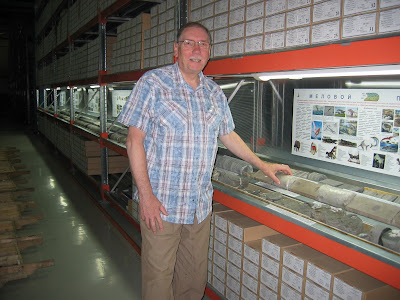
Picture: Core samples in the Kern Museum KM where oil deposits are mapped
Mr Filipenko's latest project is the redevelopment of the provincial capital Khanty-Mansiysk, a town of 60,000. The province's oil industry generates $40 billion in annual tax revenues, $4.5 billion of which Khanty-Mansi gets to keep for its own use - the rest goes to Moscow. Khanty-Mansi therefore, has an unparalleled opportunity to create modern and desirable living conditions in a region otherwise thought of as harsh and desolate.

Above: The Well Being Hotel in Khanty-Mansiysk. A perfect example of the remarkable redevelopment going forward.

Above: A fountain in KM with one of our camera men - a film of our journey will be shown on Russian Hour TV in September
The Russian Federation has benefited hugely from such profitable soil and the area has been able to buck the trend of falling populations. Unlike the country as a whole, whose population is in decline, Khanty-Mansi's has increased 18 percent since 1989. It has been subject to major social investment using oil and gas profits to build a broader and more attractive economy for the future.
Despite his party background, Mr Filipenko's vision is distinctly non-Soviet. The capital's leading architectural symbols include a shomping emporium toppoed by a giang green dome in the shame of a chum, the traditional tent used by the region's indigenous people - the Khanty, Mansi, and others who hunt, fish and herd. Such symbolism was unthinkable in Soviet times when the state denied the very idea of culturally derived identity.

Picture: With Lenin, the Czar and Orkney friends Bob Mimmer and Helen
Mr Filipenko has been able to identify the myriad political, economic, and technical challenges looming on the horizon when the monetarily rich oil injections some day dry up. Today, Ugra takes second place to Moscow on volume of capital investments, and what's more, it has the best standards of living in Russia with top salaries, state of the art nursery, hospitol and recreational facilities. My series of informal meetings and visits to facilities and cultural, health and educational institutions shows how Mr Filipenko has been able to create a vitally modern city, about the size of Inverness, from a Siberian oil camp.

Picture: Touching the newly placed Gagarin Stone set along the Skara Brae timeline in April of this year
After such collaborative success I was invited by Ugra's Governor, Mr. Alexander Filipenko, to visit the region at my earliest opportunity. Two 3 hour flights from London later and I was there. It would be 5 hours if you flew direct to reach beyond the Urals into the oil and gas rich plains of Western Siberia.

Picture: A dubious character (RG) in Moscow's Red Square
I previously met the deputy governor Oleg Goncharov in Orkney during our time working on the stone's commemoration. I have had face to face meetings with Governor Filipenko and also with his deputy chairman of government issues of Investment and Innovations, Mr Morozov (Mr Frosty - in literal translation, though he was far from that).
In Ugra there are one and a half million inhabitants living in an area the size of France. 25,000 are native Khanty-Mansiysk people who still live a traditional lifestyle to some extent. The attraction from the late Soveit times was oil. This area has helped transform the modern Russian economy. The pumping heart of the economic boom is westerm Siberia's oil fields, which produce around 70% of Russia's oil - some 7 million barrels per day. Western Siberia, it turns out, had even more oil than anyone could have imagined: more than 70 billion barrels have been pumped over the past 40 years.

Picture: Core samples in the Kern Museum KM where oil deposits are mapped
Mr Filipenko's latest project is the redevelopment of the provincial capital Khanty-Mansiysk, a town of 60,000. The province's oil industry generates $40 billion in annual tax revenues, $4.5 billion of which Khanty-Mansi gets to keep for its own use - the rest goes to Moscow. Khanty-Mansi therefore, has an unparalleled opportunity to create modern and desirable living conditions in a region otherwise thought of as harsh and desolate.

Above: The Well Being Hotel in Khanty-Mansiysk. A perfect example of the remarkable redevelopment going forward.

Above: A fountain in KM with one of our camera men - a film of our journey will be shown on Russian Hour TV in September
The Russian Federation has benefited hugely from such profitable soil and the area has been able to buck the trend of falling populations. Unlike the country as a whole, whose population is in decline, Khanty-Mansi's has increased 18 percent since 1989. It has been subject to major social investment using oil and gas profits to build a broader and more attractive economy for the future.
Despite his party background, Mr Filipenko's vision is distinctly non-Soviet. The capital's leading architectural symbols include a shomping emporium toppoed by a giang green dome in the shame of a chum, the traditional tent used by the region's indigenous people - the Khanty, Mansi, and others who hunt, fish and herd. Such symbolism was unthinkable in Soviet times when the state denied the very idea of culturally derived identity.

Picture: With Lenin, the Czar and Orkney friends Bob Mimmer and Helen
Mr Filipenko has been able to identify the myriad political, economic, and technical challenges looming on the horizon when the monetarily rich oil injections some day dry up. Today, Ugra takes second place to Moscow on volume of capital investments, and what's more, it has the best standards of living in Russia with top salaries, state of the art nursery, hospitol and recreational facilities. My series of informal meetings and visits to facilities and cultural, health and educational institutions shows how Mr Filipenko has been able to create a vitally modern city, about the size of Inverness, from a Siberian oil camp.

Tuesday, 8 July 2008
Contrast and Focus - Scotland and Ugra
The geographic, climatic and cultural differences between Scotland and Ugra are very obvious - or are they?
From Shetland to Berwick it is 800km and as narrow as 40km between the Forth and Clyde, but we also have 100 inhabited islands. Our Atlantic temperate climate includes cool, wet winters and cool, wet, slightly warmer summers. Ugra is 1,400 km from the Ural mountains in the west, across the West Siberian Plains along tributaries of the Rivers Ob and Irtysh. Its short summer, deep in the continent of Asia, is warmer than London whilst winter is a ferociously dry cold dozens below zero.
Yet the Khanty-Mansiysk [KM] Autonomous Okrug - Yugra founded in 1930 is the same latitude as Muckle Flugga and St Petersburg. Nowhere near the Arctic Circle, the view of the stereotype.
The Russian Federation has been reorganised under Pres. Putin after the free for all in the Yeltsin years, but the KM government - with one and half million population in an area the size of France - keeps a proportion of the oil revenues from the production of oil that is 70 percent of Russia's total output. It is also a significant gas exporter. Of course 80 percent plus of oil in the North Sea is in Scottish waters but all oil revenues go straight to the London Government.
What does Ugra look like? 90 percent is virgin forest, the rest bog and huge waterways. Near KM city the Ob is a kilometre wide. River transport is open here from 15 May to 15 October
and the Arctic Newport at the mouth of the river a thousand kilometres north is ice free for two months only. Hovercraft are needed to serve riverside villages on the tributaries to navigate treacherous sand banks.
In human terms the indigenous Knanty-Mansi people number 25,000. They are part of the Fenno Ugrian language group having migrated west in some numbers in the 9th century. The Soviet period suppressed all other languages other than Russian. Now the way of life, heritage and languages are promoted and taught. They bark and pole 'tipis' or chooms provide motifs in
many pieces of modern architecture in modern KM city. While the reindeer herders and hunters continue to ply their trade.
many pieces of modern architecture in modern KM city. While the reindeer herders and hunters continue to ply their trade.
The exploitation of oil was begun in Soviet times and Yugra celebrated the extraction of the 9 billionth barrel recently. 40 years of oil camps and board walks, wooden cottages and hastily built Soviet tenements are giving way to modern construction at higher standards than ever before. Scotland's thirty years of oil extraction was also celebrated this year but the social rewards of oil riches are yet to create a rich society.
Significantly, the rising prices of oil worldwide make both of our oil deposits all the more valuable. For Scotland, like Ugra, still has at least as much again to extract as it has already. Planning of the economy is coordinated by the Autonomous Government in KM. The Russian Federation owns the firms but the determination of Governor Filipenko to transform his District with oil revenues is easily seen. His vision rests on increasing the population and the modern school, a six year old university, cutting edge hospitals and School for the Gifted Children of Siberia are all manifestations. Ugra and two other Russian provinces buck the trend to falling birth-rates.
While working cities like Surgut, with 300,000 people awaiting the style of makeover achieved in KM, which is the size of Inverness. Modern public buildings concert halls and art galleries are as much a priority as housing. I saw examples of a rural government programme at Kysych [pop. 700] a river village 100 km from the city. Indigenous people are offered a three stage grant to build wooden houses themselves. Much like the Crofter Housing Grant Scheme. The ground is a peppercorn price.
I also saw one of the outpost local hospitals with various services and a midwife maternity unit. It serves a 5,000 sq km area as does the local militia man and award winning school. Its excellent performance has won a recent grant of 800,000 roubles to buy a suite of apple macs to augment its older PCs in the classrooms. From talking with the teacher of Khanty culture there I was able to see how the government teaches comparative culture in the schools.
The Congress of Fenno Ugrian language speakers preceded the EU Russia summit in KM city in June this year. These are significant events to put this go getting district on the map.
The airport allows internal Russian flights and could well be developed to bring international tourists and businesses here. I stayed in the top room in the Well Being Hotel which housed the main players at the EU Russia summit. It is four star and comfortable. I also experienced a Russian Inn about forty kms away in the outback. It was the site of a settlement in Dobrino for exiles removed there in 1932. Now broad water meadows and birch woods are far more relaxing than the struggle for survival in the Siberian winter. The wooden hotel complex could be from a scene in Dr. Zhivago. As a tourist attraction, Ugra offers summer and winter attractions and sports plus hunting and cultural activities. Whilst Ugrian oil workers would relish the scenic variety of Scotland and our mists, castles and music. The modern city of KM is a contrast to our much older established settlements and small islands.
Talking food, Russia has a good distribution system for locally and nationally sourced fresh vegetables and fruit. The river fish are very tasty too. Mucsun is a local variety to be recommended with the omnipresent cranberry juice. Visitors here should not look for McDonald's, is isn't allowed in. In return Ugra would like organic Scots lamb, beef and seafood. But not yet deep fried mars bars.
Government in Russia is not democratic as we know it. Though how democratic Britain is a conundrum too. But social, cultural and economic development comes in many varieties here. The Yugra government supports three TV stations locally where expression is much freer than Moscow channel One. All this with their norms in an autocracy. Still, think of London's grip on BBC and ITV...
So, all in all opening doors to economic cooperation would be mutually welcome. Boosting Scottish and Ugra exports key. A partnership that shares Edinburgh's financial skills, our IT specialisms and oil know how would grid with those in Ugra under a government determined to succeed in growing its population and building a distinctive future. Whilst Scotland is on the road to independence, this distinctive Russian province has the clout to decide how its resource wealth will build prosperity. Let's drink a toast in whisky and vodka to that potential partnership.
RG 8.7.8
Friday, 4 July 2008
Trench warfare in education battle
AN end-of-term report is due on my experience of the Education, Lifelong Learning and Culture Committee. It was a most confrontational experience.
advertising
Trench warfare was the order of each day, once a week during term time. The committee comprises, three SNP, three Labour, one Lib Dem and one Tory; Labour convener, Karen Whitefield; SNP vice convener, me. From the prolonged battle over the details of abolishing the Graduate Endowment we knew it would be hard.
It was rejected by the casting vote of the Labour convener but passed by Parliament with SNP, Lib Dem and Green support. This began the route to free education for Scots students and was the first step towards reducing student debt as pledged by the SNP Government.
The bulk of the session was devoted to scrutiny of an EIS (Educational Institute of Scotland) petition for maximum class sizes of 20. Indeed we spent more hours on this than on evidence for the Creative Scotland Bill despite the straightforward enabling nature of this measure.
The hostility of Unionist parties to the reduction of class sizes in P1 to P3 that is central to SNP thinking led us into tortuous and long-winded debate. From my experience few committees allow such persistent supplementary questioning without time limit. Whether it amounts to more than a hill of beans remains to be seen. Some 80,000 signed the EIS petition; teachers and academics say smaller classes are best. So the SNP has set to deliver year-on-year targets for local government to meet their Concordat obligations. Highland already has 100 of the 180 primary schools complying. So with increased capital and cohorts of teachers in training significant progress across the country is to be expected by 2011.
The Creative Scotland Bill received the grudging endorsement of the principle of a single national cultural body, to be called "Creative Scotland". However the committee expressed significant concerns as to whether the Bill as drafted will meet its objectives. In an extended dogfight, critical and nit-picking amendment after amendment was forced through, five to three. But on the floor of the Chamber the third, and final, stage was voted through unanimously only to be negated by a Lib Dem move to veto the financial resolution. This lost so the Bill fell. The culture minister Linda Fabiani has assured MSPs and the creative industries and artists that this will be rectified in the autumn. Meanwhile Creative Scotland continues to transform from the Scottish Arts Council and Scottish Screen. So gesture politics from the Unionist parties has slowed progress which the creative community should never forget.
Various personnel moves among SNP committee members have now been agreed. The moves to accommodate a member back from maternity leave, another going off and Brian Adam our chief whip to be freed up for management duties on a Wednesday morning have led to a reshuffle. I will take Brian's place as vice-convener of economy, energy and tourism while Kenny Gibson [no relation] moves from local government and communities to education lifelong learning and culture committee. My move comes at an exciting time when an energy enquiry is on the stocks. I will of course continue to serve on the transport, infrastructure and climate change committee which meets on Tuesday afternoons.
*
In a time when young people throughout the country seem to be categorised as self-obsessed, and caring more about the latest celebrity antics than the world around them, it is heartening to read the findings of NCH Scotland report called Hear our voice.
The report asked 500 disadvantaged children and young people in Scotland (including the Highlands) what their top priorities are for public policy in Scotland. The top three priorities came out as reducing poverty, tackling homelessness and providing better access to leisure and recreational opportunities.
These priorities follow a social justice agenda which chimes with that of the Scottish Government. It shows why Governments, MSPs and other decision-makers must not stop listening to the younger generation. In recent visits to secondary schools I have been impressed by the grasp that students have on important issues such as climate change and world affairs. We ignore the future at our peril and I would say we ignore the future of our young people's wishes to our detriment.
*
This year's Festival of Politics takes place in our Parliament during the Edinburgh Festival. The star turn will undoubtedly be Aberdeen-born singer Annie Lennox, who has sold 80 million records in an award-strewn career. Today she campaigns for women who are victims of HIV in southern Africa. In a newspaper interview last week she said she wanted to see a modern, forward-thinking and environmentally-friendly Scotland.
She continued, "In that way, if Scotland was to be independent, and it had that kind of vision, I would back it completely."
Next year sees the year of Scottish homecoming which will celebrate Scotland's great contribution to the world. It will also encourage people of Scots descent around the world – estimates range from 28 to 40 million people – to visit.
Tuesday, 1 July 2008

Scotland 'ideal' for low-flying? - BBC report

The C130 was put through its paces above the Scottish Highlands
BBC Scotland reporter Craig Anderson joined some of Britain's top gun pilots during an exercise to prepare them for action in combat zones.
Here he looks at the rigours of low-flying training over the Scottish Highlands and the criticism it draws.
--------------------------------------------------------------------------------
Our plane flew in low.
Very low. Hugging the landscape, the huge Hercules C130 transporter was often no more than 300ft above the heads of the startled sheep below.
The task was to rescue an infantry unit trapped in enemy territory.
We had only seven minutes on the ground to complete the pick-up while firepower from Typhoons and Tornadoes kept hostile combatants pinned down.
Happily, the landing zone was Wick airport in the far north of Scotland. This was merely an RAF training exercise.
"Of course we need defence but we must make sure it's proportionate."
-Rob Gibson, Nationalist MSP
This week some 30 extra aircraft and 500 air crew and ground staff have descended on the twin RAF stations at Kinloss and Lossiemouth in Moray.
They're taking part in the Combined Qualified Weapons Instructors Course.
It's a bit of a mouthful but the 10-day series of exercises is the culmination of six months of training for Britain's top guns.
The aim is to prove the battle-readiness of not just the high fliers but also their strategic warfare planners on the ground.
"We're testing their ability to assemble large packages of aircraft to solve particular tactical challenges," Wing Commander John Sullivan of the RAF's Air Warfare Centre explained.
"We've asked them to go and extract some British troops that have been compromised in a forward position."
Some people are concerned about low flying in the Highlands
The aerial acrobatics of the Typhoons - previously known as the Eurofighter - flying together with Tornadoes, Hercules, Nimrods and various other aircraft create a plane-spotter's delight and quite a few enthusiasts will head for Morayshire to indulge their passion.
Other observers are less convinced of the need for so many low-flying training missions over Scotland's more remote areas.
Criticising the Ministry of Defence's (MoD) recent admission that pilots deliberately use people's homes and vehicles as dummy targets, Nationalist MSP for the Highlands and Islands Rob Gibson complained that the north of Scotland gets most of the pain and little of the gain from low-flying.
He said:
"We see the MoD's behaviour as arrogant because it feels it can use the Highlands as a military playground and I believe that's got to be challenged."
Part of the objective of low-flying is to remain invisible to enemy radar and attack aircraft.
And it's not just fast jets that employ the tactic.
The Hercules seemed so much faster and more manoeuvrable than I'd expected as we dodged along glens I knew from the ground but not from the air - such as Strath Halladale in Sutherland.
On the flight deck of the C130, Flt Lt Mark "Dutch" Holland insisted the experience offered by Scotland's topography was second to none.
He said: "Scotland's ideal because when we go out to Iraq there's often large numbers of aircraft operating in a very small bit of airspace.
"Also in Afghanistan there's very large mountains and very bad weather and Scotland has both of those."
The RAF argues that for as long as crews are required to fly genuine missions in such hostile areas, then low-flying training is vital.
So Scotland looks likely to remain an invaluable training ground.
Friday, 20 June 2008
Who really gets the last word in debate?
Holyrood Diary in the John O'Groat Journal
20 June 2008
All politicians and competitors like to have the last word. Three examples in my parliamentary week come to mind. First in the Education Lifelong Learning and Culture (ELLC) Committee about how the BBC has failed to report the increasingly diverse governments of the devolved UK. Secondly in the Parliament Chamber Labour debating time focused on so-called “education cuts”. Thirdly in the political panel at the annual STUC Highlands and Islands conference held in Inverness last Saturday one of my colleagues came away with the biggest whopper as the last word.
The ELLC committee is far famed for its lengthy weekly sessions. We get endless supplementary questions as certain members seek ‘just a short extra point’. Two panels in front of us last Wednesday were from OFCOM the media regulator, then Blair Jenkins the chair of the Scottish Broadcasting Commission appointed by Alex Salmond last summer.
You can read the proceedings on the Official Report in the ELLC committee section. Also you could have watched the proceedings live, but there is no dedicated Scottish Parliament Channel to catch up later. Why not?
Coincidentally Prof. Anthony King published his own report on the BBC’s proven lack of coverage of Scottish, Welsh and Northern Irish issues on the same day. OFCOM’s answers show they too have to get used to the idea that transmitters should reach every corner of Scotland as of right. We get a very second rate service that needs sorted by spending some of the income due to London Government when it sells spectrum - that’s the bands used by broadcasters. But will they spend it on better reception in the Far North and islands?
Blair Jenkins’ evidence was corroborated by the King Report. When his final report is produced this autumn it will probably suggest that Scots must be offered not just BBC and ITV terrestrial channels but also access to a twenty more without paying through the nose to Rupert Murdoch for a satellite dish. Mr Jenkins has shown that public opinion seems to favour a change to the structure of early evening television news to provide one integrated programme from Scotland covering international, UK and Scottish news. 53% prefer this option while 36% favour the status quo.
I hope to hear Caithness voices call, not just for more local TV news, but a national service for Scotland worthy of a confident diverse nation. We deserve broadcasters that make programmes to reflect a new confidence and from the perspective of our particular view on the world that television centre has failed to reflect. The last word can’t be left to the BBC in London.
MELTDOWN was the charge levelled by the Labour party on Scottish Government conduct of education policy. Well, really? Most local councils are happy with the greater freedom to meet their education needs through the historic concordat set out by John Swinney. Indeed the recent summit between our Finance Minister and the COSLA team showed cooperation and progress. Yet Labour echoes the activists at the Educational Institute of Scotland AGM which threatened a strike ballot for the third time in six years, i.e. twice when they were at the helm before this!
In debate I mentioned the demonstration at Brora where local Labour councillors and Highland MSPs whipped up a fury at the loss of a teacher as the primary school roll dropped below the agreed pupil/teacher ratio. Did the Labour and LibDem do anything to build up the population of Brora during the past eight years? What jobs were created, what houses built, what support did they give to campaigners who wished to see a rail bridge across the Dornoch Firth that would have allowed Brora commuters by rail to work in Inverness?
Why has the school lost pupils? We were not told. Just as school rolls go down, they also go up, when numbers expand again. And the SNP Government has tasked HIE to target an increased population in East Sutherland.
In debate I also mentioned that Wick High School had been deteriorating for many years. So I believe that the SNP Future Trust will fund its replacement but without excess profits going to developers. I understand ministers are determined that schools in the poorest condition, the D band, will be top priorities.
Wick High School does not need the First Minister to visit just now. It needs the First Minister’s economic policy to succeed. We cannot allow more oil profits to pile up in Chancellor Darling’s coffers whilst denying Scotland access to funds that build our schools, our transport and our future. That’s definitely not the last word.
DONALD DEWAR the first Scottish First Minister presided over a budget of around £15 billion in 1999. In 2007 Alex Salmond Scotland’s first SNP First Minister has around £30 billion from block grant. According to David Stewart MSP speaking at the STUC gathering, Donald Dewar would have been very happy to have had the current budget. Mr Stewart implied the settlement for Scotland from Westminster is generous and by implication that the SNP is profligate. I beg to differ, for the uncosted extravagances of those past eight years are surfacing monthly.
Let’s recap, Mr Dewar did not have to fund the costs of free personal care for the elderly, nor meet the excessive costs of PFI/PPP his mentor Tony Blair so eagerly embraced. Nor did Mr Dewar have to pay for the free bus passes for the over 60s or fund the laws passed in profusion in the past seven years since his untimely death. As the current hikes in fuel and food prices also show it’s a different time we live in. Let’s not forget the 60% increase in Council Tax in the Labour LibDem years, a stealth tax if ever there was one and the costs of micromanaging nearly every sum they allocated across the land. In a word voters always have the last word so politicians beware.
rob.gibson.msp@scottish.parliament.uk
Thursday, 19 June 2008
SCOTTISH REGISTER OF TARTANS BILL: STAGE 1
Speech in the Scottish Parliament:
19 June 2008
Rob Gibson (Highlands and Islands) (SNP): Tartan is one of the priceless symbols of Scotland—money cannot buy such recognition as it gives us. There are other symbols of Scotland, but tartan is the most universally known. The tartan industry is worth an estimated £350 million each year to the Scottish GDP, so it is important. It is entirely possible for us to grow it as part of the Scottish Government's policy of enabling our economy to do better. The ECOTEC survey showed exactly how it can grow, because of tartan's marketability. The register that Jamie McGrigor proposes should not be knocked, as it has the ability to raise tartan's profile and is the key to producing real growth.
It is suggested that people invented the short kilt—the fèileadh-beag—because it was easier for quarry workers and others to work in it. The fèileadh-mòr, or large kilt—the belted plaid that Ted Brocklebank mentioned—is the garment that was banned by the orders issued after Culloden. People have a right to develop the kilt in many different forms—there are some rare sights at American Highland games—and the plaid can be worn in a modern sense. We should encourage the use of the plaid as well as the short kilts that many of us wear on special occasions.
In my view, including an official definition of tartan in the bill is a somewhat limited approach, because it is tied up with the idea that tartans must be woven. At the same time, when people are designing tartans, they will eventually want to make them out of cloth. The issue of whether they will have to produce a piece of cloth in order to register the tartan is fraught with difficulties. Of course, they must accept that Pantone colours and so on must be defined for designs. As was suggested, people must be careful, because a picture is not a tartan in itself. Looking at the tartans of different clans in books of tartans is different from seeing the woven tartans. We must find a way through all that. Perhaps we need to investigate how we can create tartan swatches more cheaply, so that people who want to innovate and create are not disadvantaged. I hope that, at a later stage in the bill, we can find out what can be done.
John Farquhar Munro mentioned copyright. We must try to work with Westminster on that, but it would be good if we could find a way of incorporating tartan copyrighting in the powers of the Scottish Parliament in order to bring that power together with the bill's powers. I say that because of the obvious way in which copyright affects Scottish things. New designs crop up all over the world. It is recorded in my register of interests that I am the president of the Kilt Society de France. People have registered tartans in
Scotland from there. They want to produce tartans and are not trying to compete with the Scottish industry in the way that Lidl tried, and such foreign producers must be encouraged, because their tartans also spread the story of Scotland.
I, too, was at the Royal Highland Show today and saw the Scottish Crofting Foundation's tartan. I said that I would give the foundation a mention in the debate. The tartan is a fine green and brown one, and it is excellent. I do not know whether I got there first with that, or whether Tavish Scott did. However, the SCF is a great example of a body producing its own tartan. I want to see whether the Scottish Rural Property and Business Association designs itself a tartan.
Subscribe to:
Posts (Atom)
